Showing posts with label tax deduction. Show all posts

Monday, December 4, 2017

Consequences of Not Thinking Things Through

Sometimes we believe that we are backing a worthy cause or making a good decision, but it turns out (sometimes too late) not to be the case.  Two recent examples in the news are trophy hunting and tax deductibility.  Though they may seem totally unrelated, they share the common characteristic that we tend not to think them through.

They both tend to be political, which makes it all the more important that we fully understand what is going on so as not to be manipulated by the opposing forces.  In these cases I am taking a critical thinking approach rather than taking sides.

In the first case, many oppose trophy hunting as treating animals badly.  There was talk earlier this year of banning imports of trophy-hunted elephants and possibly other species for that reason.  A deeper look reveals a different story.

This article from CNN explains that the major threat facing elephants and other exotic wildlife is not the trophy hunters, but other factors such as loss of habitat, retaliatory killing by local farmers and poaching.  Poachers come at night to kill the elephants for their ivory.  Controlling poaching, reimbursing farmers for crop damage and preserving the savannah requires funding.  A major source of that funding is the license fees paid by the rich trophy hunters.  As long as the hunting is well regulated, the overall impact on wildlife can be positive.

It seems counterintuitive at first glance that shooting a few elephants or lions in a well-regulated way could benefit the larger group, but it’s true.  The writer of the CNN piece admits to being a conservationist and vegetarian who wishes for a different solution, but the revenue ensures positive outcomes for animals as a whole and jobs for local game wardens.  Other sources agree, including The University of Washington’s Conservation Magazine and the National Geographic.  Yet some want to brand these fat-cat hunters as evil men who hate animals and are destroying the planet.

The second example has to do with tax deductibility, which is the subject of a fuss in Washington over a new tax law.  Various proposals intend to double the standard deduction while eliminating different itemized deductions.  But are these deductions as valuable as their backers claim?  Here is a simplified explanation.

A deduction is the amount we subtract from our income before calculating taxes.  If we earn $50,000 and have $15,000 in deductions, we pay tax on only $35,000.  Using a 15% tax bracket, the actual savings is not $15,000, but 15% of that, or $2,250 – still nothing to sneeze at.

But don’t forget the standard deduction!  You must spend that $15,000 to get the benefit, but we can subtract $12,000 without doing anything, which would reduce our taxes by $1,800 (15% of 12,000).  In this example, the difference between having the deduction and not is only $450, or 3% of the total deduction.

Now I don’t know many people who would go rushing to the store for a 3%-Off sale, but that’s not the way it’s presented.  When the state or local government wants to raise your taxes they explain how it won’t hurt you because “it’s all tax-deductible.”  When a charity wants your money they emphasize the tax-deductibility.  When a tax preparer charges $50 for software or over $100 for the personal touch, they don’t tell you that this money saved you only an incremental $450.  No, they stress the much larger number at the bottom of your return, remind you that their fee is also tax-deductible and then urge you to get your money today at their high interest rate.  (Note:  The CPA Practice Advisor says that you should expect to pay an average of $273 in the 2017 filing season if you want to itemize your deductions.)


Elected officials at all levels, charities, environmentalists, tax preparers, animal rights advocates, realtors and many others depend on the majority of us not to think too deeply.  Perhaps some of them aren’t thinking clearly themselves.  But when we just nod in blind agreement, allowing ourselves to be misled, we get poor outcomes and may never realize it.

Monday, August 14, 2017

Anticipating Panic About Tax Reform

I noticed in passing a sense of panic among a number of people over the proposed GOP tax reform plan.  I went on line to try to find the source of the information and found articles from January and April of this year and from August 2016 (based on campaign promises), but nothing about a current proposed plan.  I finally tracked down the source of the information, a local newsletter with no references cited.

The newsletter was consistent with those older sources, warning of the loss of itemized deductions and personal exemptions as the standard deduction is raised to $24,000 from the 2016 level of $12,600.  The tone was the same.  Loss of those deductions (medical expenses, state income and property taxes, home mortgage interest, gifts to charity, casualty and theft losses, and some job expenses) would be a hardship on the middle class.  This got me thinking about taxes and deductions.

Several references told me that 45% of households pay no income taxes at all.  These are typically those who don’t earn enough (not the rich using loopholes).  Their attitude should be, “Reform away; we don’t care!”

Another source tells that only about 30% of filers use the itemized deduction.  That means that only about one in six households has any stake in the outcome of this debate.  And most of those are in the upper income range.  As this graph shows the 30% average becomes 60% for those above 75k, almost 80% for those in the 100k to 200k earnings range and almost 95% for those households making over 200k per year.  The number who shouldn’t care increases to 5 out of 6.

Next let’s look again at itemized deductions vs. the standard deduction for a sample lower income family.  Remember, itemizing only starts to matter once you hit the standard deduction, because that is what you get anyway without doing anything or keeping any records.  On top of that, medical expenses don’t count until you have spent 10% of income.

For a household making $68,000 per year, approximately 20% above average, under the old plan they would subtract $12,600 and $4050 for each exemption (use $12,150 assuming a family of 3) and pay 15% of the remaining $43,250.  Under the new plan they would subtract $24,000 and pay at only 12% of the remaining $44,000.  How high would their itemized deductions have to be under today’s system to pay the same amount?

Surprisingly the answer is $32,800 (plus $6,800 more if the medical bills are used to qualify) in itemized deductions!  That’s an unusually high number of deductions for a fairly modest income.  It’s logical to conclude that any low to middle income family hurt by this would be a rare exception.

So what we are left with is speculation on what the proposal would look like and typical exaggeration about how many it would hurt and how severely.  From this cursory overview it seems the ones who would be most affected are those who buy big, expensive houses or who give to charity as a tax strategy rather than out of generosity or those unfortunates with very high medical expenses.

The problem is that I doubt anyone will look at it even this thoroughly.  Instead the parties will fight back and forth expressing shock and outrage (more outrage!) at the “rhetoric” of the other side.


Think of how easy it would be for someone to post a simple spreadsheet form on line and let each family calculate the difference between any new proposal and the current system.  This way after filling in a few numbers, everyone would know approximately where they stood without the breathless hyperbole and political spin.  Does anyone want to bet we see this kind of critical thinking scenario instead of the usual anxious generalizations about hurting the middle class or favoring the rich?

Monday, April 13, 2015

Is It Really Tax Deductible?


As we near tax day it makes sense to review a matter most people either don’t understand or don’t really think about – the issue of tax deductibility, what it really means and how people use it to sell goods, ideas and charitable causes.

Many years ago the interest you paid was all tax deductible, whether it was for credit cards or a car loan or whatever.  This changed in 1986 ending deductibility for all interest except home loans.  No doubt that the realtors and builders had some influence in the exemption of mortgage interest so they could continue to sell the advantages of deductibility. 

What happened next?  The banks began heavily marketing home equity loans.  Buy your car but use your house as collateral and still deduct the interest.  (This is another example of how we must look after ourselves rather than relying on consumer protection agencies, because when it comes to finances, bankers are a lot smarter than politicians and will come up with new products to take advantage of any rule changes.)

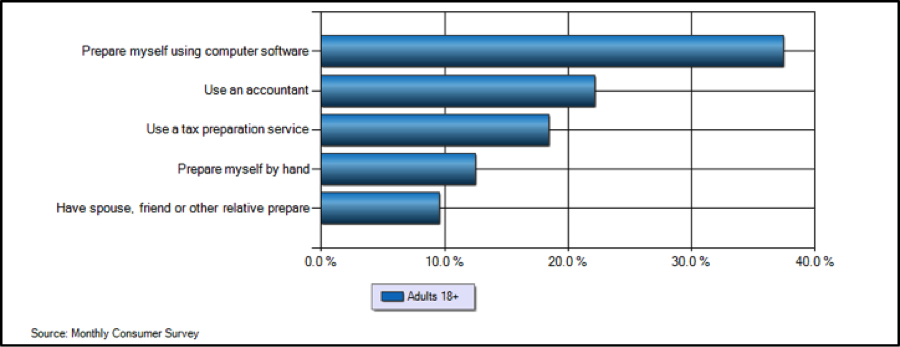
When we hear this promise of tax deductibility from anyone, what does it really mean and how much of an advantage is it?  Since fewer than one in seven people even look at a tax form anymore (see graph), preferring to hand the box of receipts off to someone else or to wade through the hundreds of questions delivered by tax preparation software that mysteriously translates all the answers into the lines on a 1040 form, I think most don’t have a clue about the mild deceit going on here.  Not everything that is legally tax-deductible and listed on your return provides any benefit at all.

Here’s how it works.  Everyone can choose either itemizing those deductions or claiming an automatic standard deduction.  Based on data from last year only about 31% chose to list all their deductions.  The rest took the standard deduction.  Deductions that may be itemized include mortgage interest, property taxes, certain other taxes, contributions to eligible charities, medical expenses (but only for the amount above 7.5% of your income) and certain other unreimbursed employee expenses, such as job travel, union dues, job education, etc.

The standard deduction, the one you could get no matter what is $6300 for a single person and $12,600 for a married couple.  So the value of the first $12,600 of deductions for a married couple (filing jointly) is exactly zero!  You could get it any way regardless of your other decisions!  Suppose you have no major health expenses, mortgage interest of $6,000, property tax of $3000, state income tax of $2500 and donations of $1500; the total is only $400 above the standard deduction.  If you are in the 25% tax bracket, your taxes are lowered by $100.  On one hand, it’s nice to get an extra $100 back from the government.  On the other hand, is that what you expected when the realtor sold you the house with the promise of tax deductibility?  (And don’t forget, the interest paid will be going down every year as the principal is paid down and the standard deduction may go up, so you have less chance to reach that break-even point.)

I know it’s usually painful to think about taxes at all, but when someone is using an idea to sell you something, it’s wise to be informed and to have done a little of the math.  In reality the only decisions that should be influenced by the promise of tax deductibility are the ones made after you know that the initial $12,600 has already been met.

Monday, March 5, 2012

The Myth of Home Equity

Back in the 1980s all the interest you paid was deductible from your income taxes:  car loans, credit cards, mortgages, etc.  In 1986 Congress passed the Tax-reform Act, ending deductibility for all interest except home loans.  What happened next?  The banks began heavily marketing home equity loans.  Buy your car but use your house as collateral and still deduct the interest.  (I always say that when it comes to finances, bankers are a lot smarter than politicians.  See blog for July 1, 2011.)

Formerly, if you took a second mortgage on your house, you were in dire financial straights, but now you were encouraged to be smart, tap your equity and be rewarded with a deduction.  What they didn’t tell you was that the equity from appreciation really wasn’t profit.  As the price of your house rose, so did the price of all the others.  Cash-in your house and you still need a roof over your head, but now they all cost more.  Equity growth through appreciation was just a way of keeping up.  Good equity comes from paying down the balance, which doesn’t happen if you keep borrowing against it.  The "American dream" is to own a house, not to live in a piece of collateral.

What else they didn’t tell you was that a house with no equity is the same as a rental with no landlord.  You are responsible for repairs and maintenance.  You have all the work of a landlord but someone else (your bank) collects the “rent” payments.

Third, they didn’t tell you that for the average person the tax deduction is at best, modest.  About 2/3 of taxpayers take the standard deduction; it does them no good at all.  If you itemize you could always have gotten the standard deduction, so you only really benefit from the amount greater than what you would have gotten anyway.  If your total deductions, including mortgage interest, are greater than $11,600 this year (joint return), your advantage over renting is only the excess, not the entire amount.  You need substantial other deductions to get the full effect, and most of us don’t.

Of course they didn’t tell you that housing prices might fall.  It was unimaginable! – until now.  Then you find yourself underwater.  The irony is that many people who got into this situation treated buying a house as an investment rather than a long-term purchase.  What else do you buy expecting it to increase in price?  Do you think about a new car depreciating as soon as you drive it off the lot?  Do you then park it on the side of the road and walk away because you owe more than it’s worth?  Have you tried to sell your refrigerator or big screen TV lately?  People who wouldn’t dream of risking money in the stock market treated a house as an investment and got burned.

Finally, they don’t tell you that if you don’t eventually pay off your mortgage, you will go on paying for the rest of your life.  It’s not good to be planning your retirement and realize that you have 25 years of mortgage payments to look forward to.  (Financial advisors will tell you never to make an extra house payment, because it's smarter to invest that money - with them, of course - who get the commission.)

This is a critical thinking issue – believing a rosy marketing picture about tax deductions and the American dream, without thinking it all the way through.

It’s also a discipline issue – looking for ways to satisfy today’s itch with tomorrow’s money.


When many behave this way, it results in serious societal consequences.