Friday, April 17, 2015

Catch Me If You Can


“It’s not a foul if the ref doesn’t see it.”  This is how some high school soccer coaches, among others, instill a sense of honor and fair play in the youth of America.  When they grow up, I suspect they turn into the kinds of whiny adults who think red-light cameras are not fair and an invasion of privacy.  When they run the red lights, endangering themselves and others, and a live cop doesn’t catch them in the act, it’s a victory over the system for these too busy, self-important, above-the-law citizens.  All those rules are only for peasants and suckers.

One would hope that this attitude and the behavior it elicits are rare, but politics in Chicago tells us different.  The USA Today reports how the issue of red-light cameras has become a political hot potato as the mayoral election draws near.  Both candidates are promising to make them go away.  Though the practice and objections are fairly widespread throughout the US, in “Chicago, which has the most expansive use of red-light cameras in the country, the public outrage over red lights has been louder than most.”  In fact, according to a local poll, “nearly three out of four Chicagoans want [Mayor] Emanuel to eliminate or reduce the use of the cameras, which are used for the detection, photographing and fining of lead-footed drivers who blow red lights.”

The leader of the opposition to this practice, “who has been hit with more than $1,000 in red-light camera tickets," (at $100 a pop) has held rallies and has a website dedicated to gathering support for their elimination.  (If it had been rattlesnakes instead of stoplights, this guy would have been dead long ago.)  But he’s not alone in thinking behavior, even illegal behavior, should not have consequences.  According to the Chicago Tribune, 4 million tickets have been issued since 2007!  (One wonders what the implications are for those municipalities considering using cameras to identify drivers who blow by stopped school buses as they load and unload children.)

Whether the cameras actually make the roads safer is unclear, but an easy way to avoid getting a ticket is not exactly rocket science.  Any third-grader could solve this one.  It’s probably “the principle” that everyone is hung up on, the principle that it’s not fair to get a ticket without human interaction; but they would be wiser (and richer) if they got hung up on the idea of personal responsibility instead – or as one contributor to the Opinion Page in Des Moines put it, “If you're guilty — and that's usually the case — pay up and shut up.” 

It's time to start taking responsibility, respecting the law as well as ordinary social conventions. Responsibility is closely related to common courtesy.  Yesterday, as we parked at the grocery store, my wife pushed someone else’s shopping cart from where they had left it eleven steps to the cart corral.  It was nowhere near a handicapped parking space, so there can be no other explanation than that the (probably overweigh and in need of exercise anyway) shopper felt that they were too busy or too important to take those exhausting and time-consuming 22 steps.  All those rules are only for peasants and suckers.

Monday, April 13, 2015

Is It Really Tax Deductible?


As we near tax day it makes sense to review a matter most people either don’t understand or don’t really think about – the issue of tax deductibility, what it really means and how people use it to sell goods, ideas and charitable causes.

Many years ago the interest you paid was all tax deductible, whether it was for credit cards or a car loan or whatever.  This changed in 1986 ending deductibility for all interest except home loans.  No doubt that the realtors and builders had some influence in the exemption of mortgage interest so they could continue to sell the advantages of deductibility. 

What happened next?  The banks began heavily marketing home equity loans.  Buy your car but use your house as collateral and still deduct the interest.  (This is another example of how we must look after ourselves rather than relying on consumer protection agencies, because when it comes to finances, bankers are a lot smarter than politicians and will come up with new products to take advantage of any rule changes.)

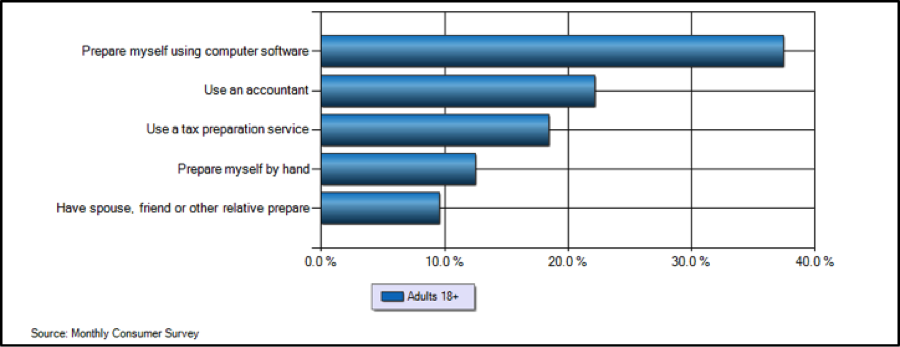
When we hear this promise of tax deductibility from anyone, what does it really mean and how much of an advantage is it?  Since fewer than one in seven people even look at a tax form anymore (see graph), preferring to hand the box of receipts off to someone else or to wade through the hundreds of questions delivered by tax preparation software that mysteriously translates all the answers into the lines on a 1040 form, I think most don’t have a clue about the mild deceit going on here.  Not everything that is legally tax-deductible and listed on your return provides any benefit at all.

Here’s how it works.  Everyone can choose either itemizing those deductions or claiming an automatic standard deduction.  Based on data from last year only about 31% chose to list all their deductions.  The rest took the standard deduction.  Deductions that may be itemized include mortgage interest, property taxes, certain other taxes, contributions to eligible charities, medical expenses (but only for the amount above 7.5% of your income) and certain other unreimbursed employee expenses, such as job travel, union dues, job education, etc.

The standard deduction, the one you could get no matter what is $6300 for a single person and $12,600 for a married couple.  So the value of the first $12,600 of deductions for a married couple (filing jointly) is exactly zero!  You could get it any way regardless of your other decisions!  Suppose you have no major health expenses, mortgage interest of $6,000, property tax of $3000, state income tax of $2500 and donations of $1500; the total is only $400 above the standard deduction.  If you are in the 25% tax bracket, your taxes are lowered by $100.  On one hand, it’s nice to get an extra $100 back from the government.  On the other hand, is that what you expected when the realtor sold you the house with the promise of tax deductibility?  (And don’t forget, the interest paid will be going down every year as the principal is paid down and the standard deduction may go up, so you have less chance to reach that break-even point.)

I know it’s usually painful to think about taxes at all, but when someone is using an idea to sell you something, it’s wise to be informed and to have done a little of the math.  In reality the only decisions that should be influenced by the promise of tax deductibility are the ones made after you know that the initial $12,600 has already been met.

Friday, April 10, 2015

Future of Retirement Dimming


I was talking to a man of about 40 the other day and he told me he expected to work until he died.  This notion was mostly driven by his desire to keep busy and keep contributing, but it also rested on his lack of faith in Social Security and other retirement systems.  Coincidentally, several new reports on all phases of that subject have been in the news lately.

Preparation for retirement has traditionally been described as a three-legged stool consisting of Social Security, pension and personal savings.  All three are in peril.

This recent NBC article gives a good description of Social Security.  It begins with the story of how the first person to collect paid in a total of $24.77 and collected more than $22,000 over the rest of her lifetime.  As incredible as it may seem, the system works exactly the same way now.  Just as her Social Security checks were funded not by some magical formula applied to her contribution but on the contribution of others, retired people today rely on those who are still working and still paying FICA taxes.  It seemed like a good idea at the time when the average life expectancy was 61 and full retirement age was set at 65.  Many people paid in and never collected.  There were far more workers than retirees.  The extra money could go into a “trust fund” giving the impression that we were saving for our own retirement instead of funding others.

Today the full retirement age has been pushed to 67, but with the life expectancy near 80 and fewer people working to support each retiree, we have reached a point where total benefits exceed income and that trust fund must be tapped.  The latest estimates predict that unless Washington makes some changes, by 2033 the extra money will run out and the income will cover only 75% of promised benefits.  (That 40-year-old will be only 58.)

The second leg of the retirement stool is the pension.  CNBC reports that between 1975 and 2011 the number of private sector workers with a pension-paying job dropped from 88 percent to about 20 percent.  (This trend continues with the latest talk of dissolving traditional defined-benefit pensions in favor of a 401(k)-type plan comes from the military as the Defense Secretary finds, “Personnel costs, such as pay, health care and retirement, have consumed an unsustainable share of the Pentagon's budget.”)  Those lucky enough to retain the promise of a pension, which includes most government workers, face the reality that not enough money is being set aside to meet those obligations.  If you are a politician, corporate officer or union negotiator, it’s easy to make promises that someone in the future will have to keep.  How many retirees will soon be forced to take less than expected as those in Detroit experienced when the city declared bankruptcy?  Cries of “you promised” and “you can’t take it away” are trumped by the economic reality that there is no magic money tree. 

What is left and what is the only thing individuals can really control is personal savings.  Again the news is not good.  The idea of an IRA or 401(k) with tax deferrals and sometimes a company match to encourage people to save is being characterized as a failed experiment.  Workers were encouraged to save but they didn’t.  As an example, the average 401(k) plan has less than $19,000 and “the median amount for savers in Vanguard between 55 and 64 years of age in 2013 was found to be $76,381.”  Less than $80,000 to last 20 years does not provide much security, especially at a time when financial advisors are wondering out loud whether $1 million is enough to retire on.

That’s the hard facts - all three legs of the stool are broken.  A little economic understanding and critical thinking lead to the conclusion that retirement is disappearing.  Everyone without the discipline to save will get to retirement and wonder what they are going to do next.  What will likely happen is that politicians will fiddle around, not wanting to put sound decisions ahead of their popularity and ability to be reelected, and end up throwing more money that the government doesn’t have at the problem until we reach the ultimate point of unsustainability.

Monday, April 6, 2015

Getting the Kids to School


Whose responsibility is it to get kids to school?  In Franklin Township, IN this question was not resolved until it reached the Indiana Supreme Court.

Franklin Township is located near the southeast corner of metro Indianapolis. 
“The population of the township as of the 2010 census was 54,594 up from 32,080 in 2000.”  The median income is of $70,000 is about 45% higher than that of the state as a whole.

The dispute began a few years ago when the school district felt they were forced to discontinue free bus service during the 2011-12 school year in response to financial pressures.  This situation of schools facing financial difficulties is not uncommon in many states where state-mandated property tax caps limit revenue.  In addition to this a state law requires that any bus service a school system does provide must be free of charge. 

In response to the threat of losing their free bussing, the parents, “upset by the district's action, filed a class-action lawsuit based on the premise that students had a constitutional right to bus service.”  (They were referring to the State Constitution that guarantees a free education to all.)  They lost the case.  The ruling was unanimous that a free education does not include all aspects of the education such as getting the kids to and from the classroom.

This behavior reflects poorly both on parental responsibility and on perspective.  First, the idea of passing off the requirement of getting your kids to school to another party smacks of not owning your problem, an unwillingness to see things through.  (If parents don’t think they even need to make an effort to get kids to school, one wonders how much interest they take in the progress their kids make while they are there.)  Remember, these are parents with above average incomes, not ones who would necessarily suffer financial hardship if required to make other arrangements.

Second is the perspective issue of taking school buses for granted.  It is just assumed that after getting the kids to the corner everything else is automatically taken care of, and that’s the way it has always been.  Children, with the help of parents, never had to find their own way to school.  Children and parents never had to adjust schedules to make sure they got an education.  Of course those assumptions are not true, and once again the behavior shows clearly where the values really are.

Friday, April 3, 2015

Homeopathy - Does It Really Work?


In a widely circulated article from the Guardian newspaper, the news from Australia is that it does not.  The headline reads: “Homeopathy not effective for treating any condition, Australian report finds.”  After a thorough and extensive review of over 200 research papers on the subject, the National Health and Medical Research Council (NHMRC) states:  “there are no health conditions for which there is reliable evidence that homeopathy is effective.”

They go on to warn that people who use homeopathic medicine as an excuse to delay or avoid professional medical help may be putting their lives at risk.

What is homeopathy?  The article describes it as the belief “that illness-causing substances can, in minute doses, treat people who are unwell,” and by diluting them in water or alcohol, “the resulting mixture retains a ‘memory’ of the original substance that triggers a healing response in the body.”  That is the theory.

Wikipedia defines it as “a system of alternative medicine created in 1796 by Samuel Hahnemann based on his doctrine of like cures like, whereby a substance that causes the symptoms of a disease in healthy people will cure similar symptoms in sick people.”

The fact that it is not effective is certainly not news as the first paragraph of Wikipedia entry immediately goes on to say:  “Homeopathy is considered a pseudoscience. It is not effective for any condition, and no remedy has been proven to be more effective than placebo.”  References associated with this conclusion date back to 2000 and earlier.  It was known for a long time, but the fact that any government agency has come out so strongly against it is new.

The industry has a different take.  The National Center for Homeopathy tells us:  “Homeopathy is a safe, gentle, and natural system of healing that works with your body to relieve symptoms, restore itself, and improve your overall health.”  “It is extremely safe to use, even with very small children and pets, has none of the side effects of many traditional medications, is very affordable, is made from natural substances, and is FDA regulated.”

One British source sees it differently.  After an extensive explanation of the theory behind it they describe it as being rooted in superstition, ritual and sympathetic magic; and cite a comprehensive study from 2005 showing that it is ineffective.  For the theory to be true “we would have to toss out practically everything we have learned over the past two centuries about biology, pharmacology, mathematics, chemistry and physics.”

It seems many people disagree with the industry portrayal.  Many studies have shown it as ineffective, but what about the claims of safety and regulation?  The US Government’s National Center for Complementary and Alternative Health is not complimentary on the subject.  “We have a fair amount of research on homeopathic medicine for a variety of conditions, but less evidence on its safety, particularly for over-the-counter products.”  The FDA does regulate it as a class of drugs, but “doesn’t evaluate these products for safety or effectiveness” and “some contain ingredients or contaminants in amounts that could cause side effects, drug interactions, or other safety concerns.”

Since those potential contaminants are so diluted, sometimes to beyond the point of detection, homeopathic medicine is probably safe but ineffective. The worst that can happen is for people to rely on homeopathy to the exclusion of professional medical help, especially if they avoid vaccinations.

So what’s the big deal?  It’s just people again throwing away money on a product that has been known for years to be ineffective.  But when a company gets you to pay money for something that doesn’t work, how can that be legal?  Doesn’t the government also have a consumer protection division to protect us from our own foolishness, like credit card scams, payday loans and fraudulent vacation schemes?  Out of curiosity I asked, “Where does the government’s Consumer Protection Agency stand on all of this?” 

Their website lists under the heading “Current Scams That You Should Be Aware Of” the following categories:  Benefits and Grants, Business, Cars, Citizenship and Immigration, Computers and Internet, Family, Home, and Community, Health and Nutrition, International Relations, Jobs and Education, Money, and Travel and Recreation.  A closer look at the Health and Nutrition link shows no mention of homeopathy (but there are a large number of other very interesting topics where Americans have been sold worthless or dangerous products).  Until there are enough complaints on this topic, I guess we are on our own.

The government can’t (or won’t) protect us from sellers of every product or service that takes our money and give us only promises in return.  Again critical thinking and just a little research can eliminate a lot of wasted time and money and possibly keep us safer.