Showing posts with label Home ownership. Show all posts

Monday, November 4, 2019

New Thoughts on an Old Idea

Looking through my various news feeds, I came across a recent reprint of an article published at Inc.com in 2017. It was called “How to Change Your Life in 5 Seconds” and gives a simple tip on how to avoid procrastination. By merely counting backward from five to zero, mimicking a NASA countdown, you can overcome the inertia that results from feeling unmotivated to do whatever comes next in life, simple decisions like getting out of bed or starting a project.

The thought behind the countdown suggestion references a Harvard Business article from four years earlier that, in turn, presents an interview with a Harvard professor who published a book in 2003, How Customers Think: Essential Insights into the Mind of the Market. The book is about how to ensure your marketing message gets through to potential customers, based on years of research and “drawing heavily on psychology, neuroscience, sociology, and linguistics.”

So what does that have to do with procrastination, or anything else for that matter? The key discovery is “that 95 percent of our purchase decision making takes place in the subconscious mind.” In fact he suggests, “95 percent of all cognition occurs in the subconscious mind.” In terms of buying behaviors, we leap before we look. Decisions in general are not based on logic or rational thought. “They're based on emotion, on how a person feels about the action.”

It follows that if you give yourself time to think about not feeling like getting out of bed or not feeling like doing whatever needs to be done next, the result is procrastination. The countdown is a conscious effort to block those feelings and, in those 5 seconds, it’s possible to be out of bed already or taking the first step toward any other task that lies ahead.

But this practice could go beyond the simple, everyday decisions. According to the original source, the same appears to apply to buying decisions as well – and we don’t only buy material goods, we buy ideas and opinions.

Take as an example the common tips for selling a house. Some include: half-empty closets; turning on all the lights; clean or new curtains, door handles and cabinet hardware; inexpensive shrubs and brightly colored flowers for curb appeal; cut flowers or cookies in the entryway instead of the more typical coatracks and key hooks. All this is superficial. It targets the emotions, the feelings, the 95%. It’s manipulative, and it works.

This goes far beyond buying a house. Retailers study how they can get us to buy more: One site lists 15 tricks such as:
  • Oversized sales signs;
  • Shopping carts at the entrance to inspire larger purchases;
  • High profit items at the front of the store so you have walk past them to get to essentials, which are in the back of the store;
  • Most profitable items at eye-level;
  • Music to make shopping fun;
  • Plenty of elbowroom;
  • Customer rewards cards;
  • Low-cost impulse items at the checkout; and
  • Limited time offers, vanity sizing, and other psychological tricks.
One age-old piece of advice to overcome these mind games is to make a shopping list (of items, or features in the case of a larger purchase like a house or car) and stick to it. Also, what if everyone did a countdown before putting something in the cart? What if everyone did a countdown before driving into the car lot? What if everyone did a countdown before believing what we hear or see on social media, on ads from purveyors of health and beauty miracle products, on the national news or in political speeches? 

Use the countdown trick as a safeguard to buy just enough time to let the critical thinking kick in. Make it your trick to defend against their tricks. Use it to protect yourself from the marketing ploys and emotional appeals aimed at that vulnerable 95%.

Monday, April 27, 2015

The American Dream Scam


I was shocked and surprised when I came across this article.  The title, “9 things that rule about owning a home” got my attention right away.  As I read through the nine categories I found what I expected to find, traditional and promotional information about home ownership that is either partially or mostly incorrect.  Here they are.

1.     Your money's going to you, not to a landlord.  It goes on to explain that with renting “you're just renting space,” but “money that you put into your home builds equity, the value of your home after the mortgage is subtracted. Loans taken out against your home's equity can be used to put money towards other things, such as college education.”  In reality, especially with the popularity of very low down payment mortgages, most of your payments for the initial years go to interest.  True, you are not renting space; instead you are renting money.  Before the turn of the century, the value of houses increased at approximately the rate of inflation.  You didn’t sell a house at a profit unless you intended to buy a smaller house.  About twenty years ago this changed, but we learned (or at least some of us learned) from the recession resulting from the overdue correction that the surge in housing values was mostly artificial.  Finally, the rate for home equity loans is lower, but that’s because you are risking your house, using it as collateral and exposing yourself and your family to foreclosure if it’s not paid back.
2.     You get tax benefits.  As I explained in detail two weeks ago, the tax deduction is partial at best.  About two in three do not itemize deductions so it does them no good at all.  Those who do benefit only to the extent that their total deductions exceed the standard deduction, which is automatic.  In nearly every case the tax benefits of paying a mortgage are either non-existent or exaggerated.
3.       It's forced savings.  The argument is that “those payments are coming back to you in the form of home equity, which increases your net worth.”  It may increase your wealth on paper, but if you sell the house that equity is swallowed up on a down payment for the next one.  Eventually you will have an asset that is all yours, but it’s not a very liquid asset because you still need some place to live.
4.     You get more for your money.  Sometimes this is true and sometimes it’s not.  The balance between buying and renting fluctuates based on supply and demand in the respective markets.
5.     You have the freedom to make it home.  The argument here is that you don’t need a landlord’s permission to make changes.  You can fix up everything the way you want it.  But you also need to fix everything that goes wrong and pay for it yourself.  I’ve heard it said (and experienced it myself) that when you buy a house you get a hobby:  repairing, replacing and maintaining or researching for a reliable person to do it for you.
6.     You can have pets.  Some rentals also allow pets.
7.     You'll love the stability.  Stability is one side of the coin.  The other is finding that you must move and are stuck with two mortgages until you find a buyer for the first house.
8.     You know everything about the place, because the bank required an inspection, which you paid for, before you moved in.
9.     It’s yours!  "You feel empowered that you actually own something…like you have a piece of the American dream."  Wow, if they can’t get you with the first eight, why not appeal to your ego?

Those are nine very weak reasons to buy a house, every one of them partially or mostly untrue.  I don’t think I am being unusually fussy when I point out that many of these fall under the category of what “Robert J. Samuelson termed a ‘psycho-fact,’ [a] belief that, though not supported by hard evidence, is taken as real because its constant repetition changes the way we experience life.”  As many people found out over the past 10 years, buying a house is not something to be taken lightly or to be done without reading the fine print and fully understanding the situation.

Monday, April 13, 2015

Is It Really Tax Deductible?


As we near tax day it makes sense to review a matter most people either don’t understand or don’t really think about – the issue of tax deductibility, what it really means and how people use it to sell goods, ideas and charitable causes.

Many years ago the interest you paid was all tax deductible, whether it was for credit cards or a car loan or whatever.  This changed in 1986 ending deductibility for all interest except home loans.  No doubt that the realtors and builders had some influence in the exemption of mortgage interest so they could continue to sell the advantages of deductibility. 

What happened next?  The banks began heavily marketing home equity loans.  Buy your car but use your house as collateral and still deduct the interest.  (This is another example of how we must look after ourselves rather than relying on consumer protection agencies, because when it comes to finances, bankers are a lot smarter than politicians and will come up with new products to take advantage of any rule changes.)

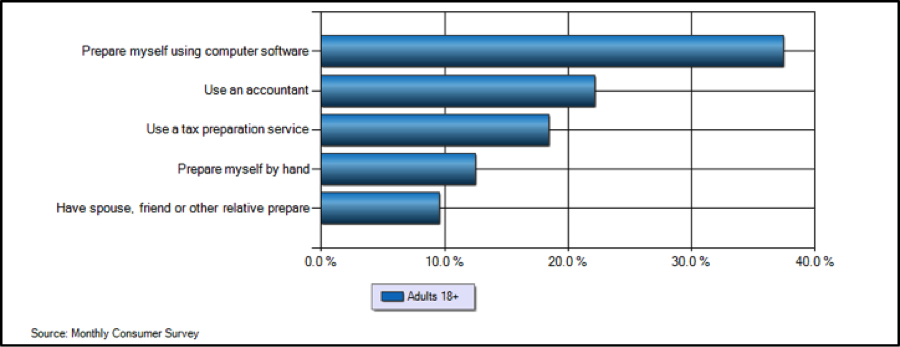
When we hear this promise of tax deductibility from anyone, what does it really mean and how much of an advantage is it?  Since fewer than one in seven people even look at a tax form anymore (see graph), preferring to hand the box of receipts off to someone else or to wade through the hundreds of questions delivered by tax preparation software that mysteriously translates all the answers into the lines on a 1040 form, I think most don’t have a clue about the mild deceit going on here.  Not everything that is legally tax-deductible and listed on your return provides any benefit at all.

Here’s how it works.  Everyone can choose either itemizing those deductions or claiming an automatic standard deduction.  Based on data from last year only about 31% chose to list all their deductions.  The rest took the standard deduction.  Deductions that may be itemized include mortgage interest, property taxes, certain other taxes, contributions to eligible charities, medical expenses (but only for the amount above 7.5% of your income) and certain other unreimbursed employee expenses, such as job travel, union dues, job education, etc.

The standard deduction, the one you could get no matter what is $6300 for a single person and $12,600 for a married couple.  So the value of the first $12,600 of deductions for a married couple (filing jointly) is exactly zero!  You could get it any way regardless of your other decisions!  Suppose you have no major health expenses, mortgage interest of $6,000, property tax of $3000, state income tax of $2500 and donations of $1500; the total is only $400 above the standard deduction.  If you are in the 25% tax bracket, your taxes are lowered by $100.  On one hand, it’s nice to get an extra $100 back from the government.  On the other hand, is that what you expected when the realtor sold you the house with the promise of tax deductibility?  (And don’t forget, the interest paid will be going down every year as the principal is paid down and the standard deduction may go up, so you have less chance to reach that break-even point.)

I know it’s usually painful to think about taxes at all, but when someone is using an idea to sell you something, it’s wise to be informed and to have done a little of the math.  In reality the only decisions that should be influenced by the promise of tax deductibility are the ones made after you know that the initial $12,600 has already been met.

Friday, May 16, 2014

Your House is NOT an Investment


Recent news reported the 100 hardest hit cities where the mortgage crisis lingers.  Homeowners are “stuck in loans for more than their home is worth.” This situation of “negative equity” or being “underwater” ranges from 22% to 56% in these metropolitan areas with Hartford, Connecticut the highest.  It’s not only an East Coast issue, though, the problem is shared by cities like St. Louis, Milwaukee and Seattle.

One problem is that people have been led astray by the realtor’s and financial advisor’s propaganda about the “American dream.”  There is no shame in renting.  In fact where there are commonly two categories on credit applications and other paperwork:  rent or own, there should probably be three:  rent, own, or buying.  This would remind us that anyone paying a mortgage does not yet own the house, as many who went through a foreclosure now understand.  And those who are “underwater” right now are less well off than renters, since they are making monthly payments but can’t easily “break the lease” if a better opportunity arises or call the landlord to take care of maintenance problems.

A house should not be considered an investment.  This only encourages Americans to buy more house than they need and, in some cases, more than they can afford.  Advisors tell us that it is an investment, using the leverage of borrowed money, not our money, to purchase an asset that will appreciate.  We have little at stake, but get to keep all the appreciation in value.

But investments are risky.  Sometimes they don’t appreciate.  Sometimes, though rarely, houses lose value.  This has been the case lately.  “After bouncing back smartly in 2012 and most of 2013 following the 2006-09 real estate crash, the housing market began slowing last fall.” That’s eight years of turmoil, and the investment at risk is the roof over your head (and your family).

In the whole housing-as-an-investment game, some have been lucky and some have been very unlucky.  When we retire, we still need a roof over our heads.  So when it’s time to cash in our investment, we get the often impractical advice to downsize or move to an area of lower housing prices or take out a high-cost reverse mortgage.  Wouldn't it make more sense to live in the right house in the first place with retirement savings in more accessible assets?

Friday, August 10, 2012

Down with Home Equity Loans


Driving past a local bank recently, I was surprised (perhaps even mildly shocked) to see a sign reading: “Put your home equity to work for you.”  What could they be thinking?  Well, the banks are thinking that they can make a loan and collect fees and interest.  The customers are likely not thinking very clearly.

There are still so many people with zero or even negative home equity, owing more than the value of the house, “upside down” or “under water” from the Great Recession.  They believed the line the banks (and realtors) fed them about putting almost nothing down and counting on the market to push the prices up steadily.  When the bubble burst they were left holding the bag.  Some walked away and some were evicted but many lost their houses.

Now, before the economy has fully recovered, banks are at it again.  The advice you get from bankers, realtors and financial advisors serves their purposes,  not yours.  It produces interest, fees and commissions.  A house is not a good investment.  It’s usually hard to sell, so you can’t get your money out right away for emergencies.  It doesn’t always appreciate.  The tax deduction is less of a benefit than most people understand (see The Myth of Home Equity, March 5, 2012).  The government only helps you pay a portion of your interest and you still pay more than you borrow.  Finally, when you do sell it, you still need some place to live!  That means you have to buy another house that has been going through the same market changes.  Unless you are a speculator, timing the market, or willing to put a lot of time and energy into a fixer-upper, you have to be very lucky to come out ahead.

Those advisors continue to call it an investment, buy a house bigger than you need (paying interest and sales commissions) and count it as retirement savings or keep cashing in your home equity to invest in the stock market (paying more sales fees) where it will grow more quickly or, worst of all, take the money out and reward yourself with a nice vacation – “You owe it to yourself; you’ve worked so hard, etc.”

Well call me old fashioned, but my advice is build up that equity and don’t even think of it as equity or an investment.  Think of it as having a roof over your head that no one can take away from you.  When the market goes up, good.  When it goes down, too bad, but at least you don’t have a bank or collection agency knocking on the door.  You’ll never be able to afford your neighbors' luxuries or exotic vacations, but you won’t have their headaches either.  This behavior is not possible for everyone.  I understand there are exceptions and personal situations.  But when you drive by the sign tempting you to “Tap your home equity,” I think you will be a lot happier in the long run if you just keep driving.

Monday, March 5, 2012

The Myth of Home Equity

Back in the 1980s all the interest you paid was deductible from your income taxes:  car loans, credit cards, mortgages, etc.  In 1986 Congress passed the Tax-reform Act, ending deductibility for all interest except home loans.  What happened next?  The banks began heavily marketing home equity loans.  Buy your car but use your house as collateral and still deduct the interest.  (I always say that when it comes to finances, bankers are a lot smarter than politicians.  See blog for July 1, 2011.)

Formerly, if you took a second mortgage on your house, you were in dire financial straights, but now you were encouraged to be smart, tap your equity and be rewarded with a deduction.  What they didn’t tell you was that the equity from appreciation really wasn’t profit.  As the price of your house rose, so did the price of all the others.  Cash-in your house and you still need a roof over your head, but now they all cost more.  Equity growth through appreciation was just a way of keeping up.  Good equity comes from paying down the balance, which doesn’t happen if you keep borrowing against it.  The "American dream" is to own a house, not to live in a piece of collateral.

What else they didn’t tell you was that a house with no equity is the same as a rental with no landlord.  You are responsible for repairs and maintenance.  You have all the work of a landlord but someone else (your bank) collects the “rent” payments.

Third, they didn’t tell you that for the average person the tax deduction is at best, modest.  About 2/3 of taxpayers take the standard deduction; it does them no good at all.  If you itemize you could always have gotten the standard deduction, so you only really benefit from the amount greater than what you would have gotten anyway.  If your total deductions, including mortgage interest, are greater than $11,600 this year (joint return), your advantage over renting is only the excess, not the entire amount.  You need substantial other deductions to get the full effect, and most of us don’t.

Of course they didn’t tell you that housing prices might fall.  It was unimaginable! – until now.  Then you find yourself underwater.  The irony is that many people who got into this situation treated buying a house as an investment rather than a long-term purchase.  What else do you buy expecting it to increase in price?  Do you think about a new car depreciating as soon as you drive it off the lot?  Do you then park it on the side of the road and walk away because you owe more than it’s worth?  Have you tried to sell your refrigerator or big screen TV lately?  People who wouldn’t dream of risking money in the stock market treated a house as an investment and got burned.

Finally, they don’t tell you that if you don’t eventually pay off your mortgage, you will go on paying for the rest of your life.  It’s not good to be planning your retirement and realize that you have 25 years of mortgage payments to look forward to.  (Financial advisors will tell you never to make an extra house payment, because it's smarter to invest that money - with them, of course - who get the commission.)

This is a critical thinking issue – believing a rosy marketing picture about tax deductions and the American dream, without thinking it all the way through.

It’s also a discipline issue – looking for ways to satisfy today’s itch with tomorrow’s money.


When many behave this way, it results in serious societal consequences.

Monday, October 3, 2011

Words People Use

Early in my career my job involved administering a union contract, one that had a protection clause that was somewhat controversial.  Management called it “comparison” and the union and workers called it “regression.”  You only had to listen to the choice of words to tell where the speaker stood on the issue.

Since then I have become sensitive to the way others use words to try to influence me as I try to make rational decisions politically and economically.  In politics it’s more transparent, for example, some talking about inheritance tax and others about death tax, but there are a few in advertising that seem subtler.

One that is especially widespread is the substitution of the word home for house.  In general usage, a house is a structure where people might live.  A home on the other hand connotes something more personal, defined in one source as “the place in which one's domestic affections are centered.”  Accordingly realtors don’t sell houses any more; they sell homes.  We are enticed to look for new homes at a parade of homes.  It was a very clever marketing strategy to get buyers to think of the touchy-feely aspects of the transaction and react emotionally to “the home of your dreams” or to fall in love with a home, but it seems to have caught on everywhere.  I rarely hear people referring to the places where they live as their house.  It’s their home, and they may have a second home or a vacation home somewhere.  They buy homeowner’s insurance in case it burns down.  I wouldn’t be surprised if soon they don’t have a dog home in the back yard with a bird home hanging from the tree!  Does “the American dream of owning a home” imply that an apartment or rental property cannot be made into a home with love and care?  The real estate industry probably hopes so.  This has become so widespread that I recently saw a religious wall hanging saying, “Bless this home”, rather than using the traditional wording of house.

Of course there are others trying to change our vocabulary to their advantage including:  car dealers selling pre-owned cars as if to imply that someone only owned it for a while, but didn’t really use it; executives calling us associates instead of employees, then going out of their way not to associate with most of us – too important/busy for that; or restaurants and hotels calling us guests instead of customers.  (Well, if I’m your guest, why are you making me pay?)  I received a survey from a restaurant asking me to compare them to other “rapid service” establishments.  Maybe the term they used was “swift service,” but it definitely wasn’t “fast food”!  Good luck with that one!

It’s all a ploy to get us to switch off our Critical Thinking mechanism long enough to slip one by us.  I’d rather see the actions/results that they are trying to portray with these words than the fancy marketing terminology.